PERFORMANCE AS A RETURN TO IMMANENT ANIMALITY


An examination of the similarities of self-aware art and occult practices

Performance is something which is always dependent on a context, this context being the venue, the audience, the social and economic purpose etc. In the latter half of the twentieth century we see many art forms that are more self-aware of their context, hence the creation of performance art – an artistic practice that has the questioning of a performance’s context as its core purpose and value. According to Patricia Waugh, this is a method of artistic creation that “self-consciously and systematically draws attention to its status as an artefact in order to pose questions about the relationship between fiction and reality”[1]. Examples of this are artworks such as Duchamp’s Fountain, John Cage’s 4’33 and many more. Specifically, in performance art the line between fiction and reality is at its thinnest and therefore performance artists can be seen as manipulators of reality.  This manipulation is the conjuring of what Eldritch Priest calls Hyperstition, ‘a fiction that makes itself real by affective insinuation, by gut reactions that contaminate the nervous system with the intensity of nonbelief. Hyperstition is a pre-personal and unconsciously exercised conviction that cannot help but register as the reality of a situation’[2]. He continues by illuminating the similarities of the creation of hyperstition to the occult practice of Chaos Magick, which is a modern magical practice that doesn’t follow specific spiritual tradition. A chaos magician doesn’t necessarily believe in deities and spirits, but in human belief and expectation, therefore deeming chaos magick a ‘spin on reality’[3]

Performance artist are mostly viewed as lazy and non-artists; however, their training can be very complex. To manipulate reality in order to create a fiction is a very delicate procedure. According to the artist Marina Abramovich, what a person needs in order to make a performance art work successful is a sense of nowness that, according to her, creates a type of energy. The artist can be doing the most every day action in the most every day space, but what makes the performance is his/her radiant energy/presence that seeps into the space. This is what makes up for the non-existent (physical) stage and crowns the persons actions as a performance. This energy/presence is an animalistic, immanent quality that exists in all people and can be accessed by means of meditative methods. In her ultimate work The Artist is Present, Abramovich sat on a chair for eight hours a day, for three months and just stared the person that sat in the chair opposite her in the eyes. This work was a clear exposition of this shaman-like energy.  

The words immanent and animalistic are reminiscent of Bataille’s Theory of Religion, in which he talks about imminent and transcendent violence. Transcendence in this case is seen as the human’s transcendence from the animalistic natural order, to the order of things. In the order of things, humans believe they can see the world from a perspective as if they are outside it and have given objects utility, therefore making them into things that have a use in the future. Transcendence hereafter is something that creates duration, everything is done for a future purpose – we go to school to study, we study to be employed, we need employance to live and so on. This creates a never-ending cycle of utility. Animals, on the other hand, do not act for the future, they act for the moment and that’s why they are immanent. Immanence, for Bataille, comes hand in hand with intimacy. Intimacy in the sense that there is no hierarchy or differentiation between animals, they are ‘like water in water’[4]. He gives the example of one animal eating another, in which case ‘there is no transcendence between the eater and the eaten; there is a difference, of course, but this animal that eats the other cannot confront it in an affirmation of that difference’[5]. This is immanent/intimate violence, whereas transcendent violence is based on a constructed hierarchy or a strive for the possession of an object of durational utility – I can torture you because you are my slave – we kill to get money or fame – we fight for land.   

Humans according to Bataille still get glimpses of this imminence in sexual and sacrificial acts where the overflow of energy and the objects of utility are wasted. Sacrifice is an anti-utility act. Maybe this is what Abramovich strives for? The return of the performer to absolute presence through ‘wasting’ time through meditation. This immanence gives the performer a conviction because he/she loses all inhibitions that come through rationalism and reflective thought, which are acts of duration. It’s quite ironic that art that is so self-aware in its form wants to completely get rid of any reflection in the moment. It’s as if the form and the technique needed for the preparation is acquired through what us humans have conditioned ourselves to do, to reflect, but the actual performance is a complete striping away from that. Maybe people really enjoy seeing animals perform in the circus because they are unpredictable, and maybe that is what they want the performer to be – an unpredictable present animal. Maybe, therefore, we can call the relationship between a controlling composer and a performer sadistic. Because the transcendent composer violently expects the performer/animal to do exactly as he/she is told. 

In sacrifice, by wasting the utility of an object, the object returns to the immanent, where objects become spirits that coexist in a non-hierarchical homogenous world[6]. This is exactly what Genesis P-Orridge and Lady Jae (Jacqueline Breyer) did when they started the project of the Pandrogyne. The Pandrogyny project was a durational performance in which the two lovers started by sacrificing their individual identities and creating one pandrogenous being/spirit called Breyer P-Orridge. The procedure of submergence involved them getting plastic surgery to look as similar as possible. Genesis, years after the death of Lady Jae stated: “We started out, because we were so crazy in love, just wanting to eat each other up, to become each other and become one. And as we did that, we started to see that it was affecting us in ways that we didn’t expect. Really, we were just two parts of one whole; the pandrogyne was the whole and we were each other’s other half”[7]

One could say that the pandrogeny project was such an extreme attempt to prove its point, but so are so many other works of art. I believe that Abramovic and P-Orridge would agree with Bataille’s and Foucault’s definitions of limit experiences, where divine ecstasy is also extreme horror[8]. Limit experience, according to Foucault, is “the point of life which lies as close as possible to the impossibility of living, which lies at the limit or the extreme”[9]. These experiences are also where man is closer to spirit because he is closer to death. 

Many artists have played with this idea of near-death danger. One of them is Franko B in his Work I Miss You, where he walked naked down a catwalk with cannulas in his elbows, leaving a trail of his blood behind him. Franko states that his body in this work represents “the sacred, the beautiful, the untouchable, the unspeakable, and for the pain, the loss, the shame, the power and the fears of the human condition” (as cited at tate.org.uk, publications, Franko B I miss you, 2015)[10]. It is a work that perfectly reflects on the animalistic intimacy that Bataille writes about, but it also is a work of extreme horror and extreme transgression that forces the audience to be present. Apart from that its extreme transgression places the audience in a position where they are to decide if they are going to deny, neutralize and then accept or just plainly accept this transgressive act for what it is. The acceptance of it leads to the demolition of many taboos and constructed ideas of beauty and socially accepted behavior, and this is one of the main purposes of this type of art. Franko B’s performance can easily be compared to a Horror film in terms of audience experience, and as Henry Jenkins has said: “The best artists working in the horror genre don’t just want to provoke horror and revulsion, they want to slowly reshape our sensibilities so that we come to look at the most outré images as aesthetically pleasing and erotically desirable”[11]. However, for the performer this extremity, apart from an exciting experiment, is also a way of achieving a ’superhuman’ type presence. Even in more mainstream musical cultures like 60s rock and roll we see the use of limit experience as a means for the transcendence of human transcendence – which is the return to animality. Sex, drugs and rock n’ roll is an attempt to reach an altered consciousness, a phenomenon which is commonly seen in many shamanic practices across the globe. 

Returning to the pandrogyne, Genesis P-Orridge has also stated “we wanted a word without any history or any connections with things – a word with its own story and its own information”[12]. This makes a lot of sense if one applies the register theory by French philosopher and psychoanalyst Jacques Lacan. He divides reality into three registers: the imaginary, the symbolic and the real – the imaginary being the internal register of images and dreams where one imagines one’s self in between others, the symbolic being the register that is completely constructed of the way we communicate our ideas through speech, images and symbols (the linguistic field), and the real -what something actually is beyond its formal symbolization and phenomenal appearance – which we can never quite grasp. Lacan states that we are born in a pre-existing symbolical order[13], because the symbols of the culture we are born in are already there. The symbolical order is something that we can never really escape because we can only communicate and think in words. Bataille also uses the term real order (or real order of things) but it is important to clarify that it is very different to the Lacanian Real. If we draw a comparison between the two theories, we can see that the real order in theory of religion is closer to the Lacanian symbolic register, because it is an anti-intimate register of words and therefore human transcendence, whereas the Lacanian Real is closer to immanence – it is something that we cannot quite understand rationally with words. 

By creating new words, like pandrogyne, we do not escape the symbolic order, but we do escape what could be the rhetoric of a culture that has a complex and heavy backdrop. And maybe this is what self-aware art does, it questions this rhetoric by transgression and creates new symbols of chaos and nonsense – symbols that can only have a vague interpretation, that leave logical gaps – symbols that because of their non-sense break, even momentarily, the world of utility. Empirically, one can say that these are the gaps in linear reality where one can be manipulated by the artists, but if one is more analytical and bears in mind the theories that I have posited one can say that; these gaps are like poetry, their nonsense breaks utility and returns us to the mythical order of spirits and in them we get a glimpse of our long lost animality. ‘The animal opens before me a depth that attracts me and is familiar to me. In a sense, I know this depth: it is my own. It is also that which is farthest removed from me. That which deserves the name depth, which means precisely that which is unfathomable to me. But this too is poetry…’[14] 

Bibliography


[1] Priest: Boring formless nonsense, 201 (as sited in Waugh: Metafiction, 2)

[2] Priest: Boring formless nonsense, 201

[3] Priest: Boring formless nonsense, 233

[4] Bataille: Thoery of Religion, 19

[5] Bataille: Theory of Religion, 17 -18

[6] Bataille: Theory of Religion, 37

[7] The Suicide Girls: Genesis P-Orridge Body Politics

[8] Biles: Ecce Monstrum, 8

[9] Fouccault:The experience Book, 30 -31

[10] Heathfield: Live: Art and Performace, 218 – 228

[11] Jenkins: The Wow Climax, Matthew Barney

[12] Musto: The village Voice, Genesis P-Orridge on Pandrogyny and Surgery

[13] Digital Culture: Jacques Lacan – Register theory

[14] Bataille: Theory of Religion, 22
Sample reading

Spine is the third of the solo pieces of Sigil music that I composed for my friend composer and pianist Athanasia ( https://soundcloud.com/philip-rousiamanis/spine-demo ).

It is a piece for piano and backing track that I have decided to arrange/recompose for wind quintet and backing track. Arrangement can be quite a tedious and mechanical task, so I did a Tarot reading to give it some intention and interest.

The music’s question is: How will I be in this new form? How will I change?

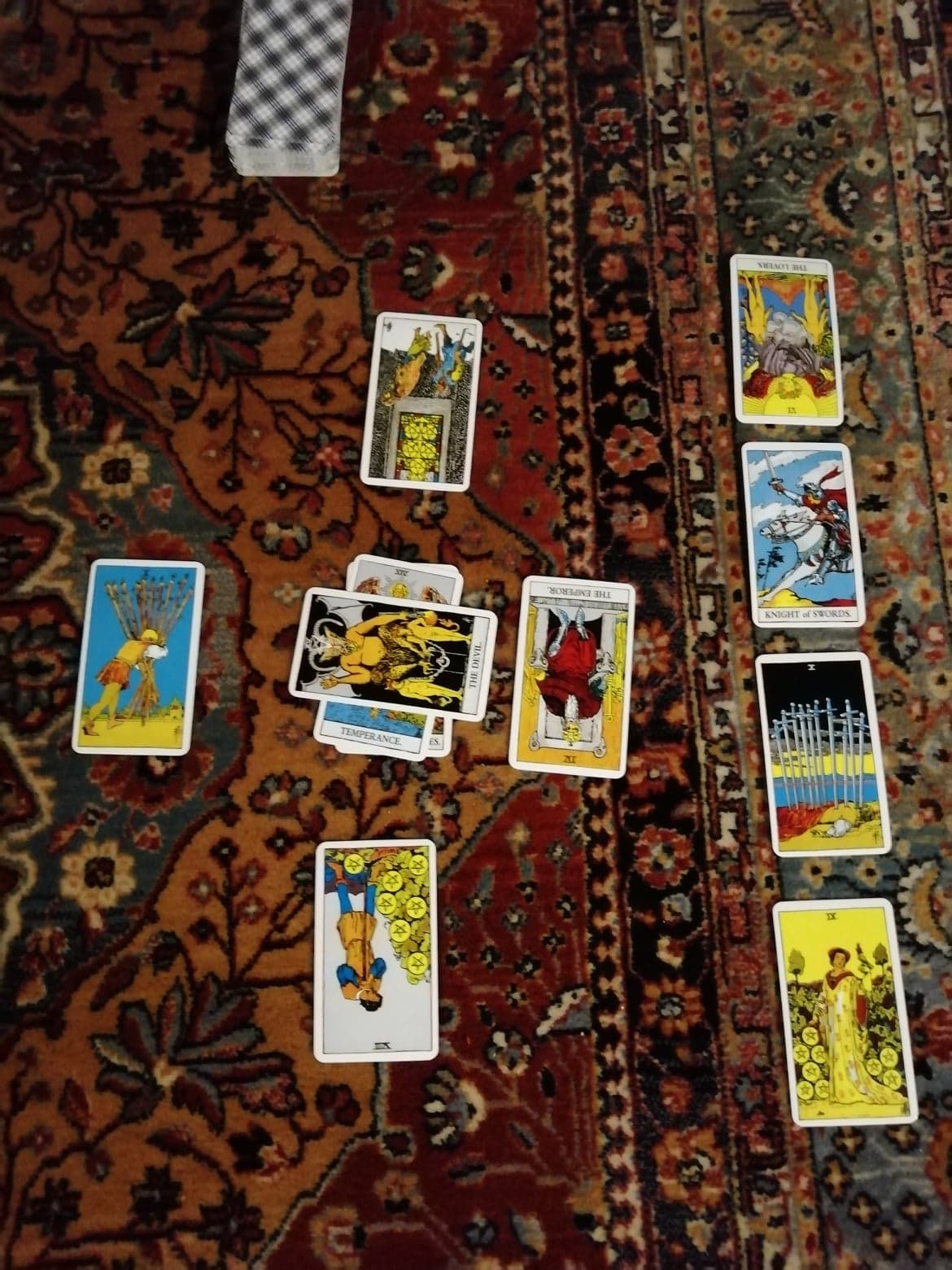
This is what the cards answered:

The vertical card of the small central cross:

Position meaning: The representation of the situation in general.

Card: TEMPERANCE

Meaning: A situation of balance. In this instance, possibly because the piece is quite obviously suited to an ensemble like wind quintet because of its polyphonic nature breadth of colour. The angel on the card pours water from one chalice to another, however the chalices are positioned in a way that the act of pouring looks unnatural or’magical’,which therefore indicates the action of arrangement and re-positioning of things. The angel’s one foot is on land and the other on water, representing the divine knowledge that comes from balancing the functions of the conscious and subconscious mind. Here, we question what a musical piece’s conscious and subconscious is? There isn’t a specific answer but it is important to illuminate the tension between the two. A good example for this is Wagner’s Tristan and Isolde: where we can say that the subconscious is the constant longing for resolution and the conscious is the act of trying to get there. This reflects the narrative through Wagner’s use of harmony. There is a constant longing for resolution (subconscious) and the harmony continually is trying every single possibility it can to fulfil this (conscious) but ends up constantly transposing. So we could say in this case that the conscious is the harmonic micro-structure and the subconscious the macro-structure. This is not always the case, however asking this question will expose the complicated and dual nature of human intention and action portrayed in music.

Horizontal card of the small cross:

Position meaning: Obstacle

Card: THE DEVIL

Meaning: The devil often shows us a position where one is completely bound in hers/his superficial/material desires. A position of half knowledge which leads to enslavement and bondage. Musically, this can be the indulgence in unnecessary virtuosity or denseness of orchestration. Some times the simplest things are the most effective.

Alternate reading of the small cross:

The small cross can also be seen as a representation of ‘vertical’ and ‘horizontal’ time. The first being the spiritual time or eternity and the second being the time we consciously measure. Spiritual experiences are said to be non-temporal because they are always in rhythm with the universe which is eternal or a-temporal. Rachel Pollack in seventy-eight degrees of wisdom says: ”vertical and horizontal time derive from symbolic interpretations of the crucifixion, where Eternity, embodied in Christ as the Son of God, intersected the ‘horizontal’ movement history, that is, the death of one human being.

If we see it like this the vertical card is the person’s inner universe and the horizontal the his/her actions. So, in this case, Temperance is the inner stability and balance of the person, but the Devil shows us that their actions are quite indulgent. Indulging is not always something that leads to bondage, occasionally it can be very freeing. In the Devil card the two people are held on chain leashes, but they are both loose around their necks, which implies that freedom is their choice. The Devil can be a card of allowing one’s self to indulge, which can also lead to freedom.

Bottom card of the big cross:

Position meaning: Basis of the situation/problem.

Card: Seven of Pentacles reversed

Meaning: The seven of pentacles is a card of satisfaction caused by material success. The figure is looking down on the material possessions he earned and worked for with contentment. Reversed cards though usually represent some kind of energy blocking or energy reversal. Here, I see a dissatisfaction about his work, not because of laziness or poor intention but because of overworking and worrying – not letting things grow naturally. Like a farmer who can never be too in control of his crops. Its a card that shows us that not all is in our control. We need to know how much to let go and let nature take its turn. In terms of the arrangement this card shows me that the music wants to be as natural as it can, that I don’t need to make it sound very artificial just in the name of experimentation.

Left card of the big cross:

Position meaning: Recent past. A phase that is just finishing.

Card: Ten of Wands

Meaning: A figure overwhelmed by work and responsibility. Both of which he has taken up because of the wand cards’ fiery urge to react to every stimulus because wands are all cards that mainly represent action/fire. However this tendency has costed its freedom, which he clearly craves. I see this card as a commentary on the previous version of the piece.

Upper card of the cross:

Position meaning: Possible outcome

Card: Five of Pentacles reversed

Meaning: Collapse and ruin, and judging from the previous card, of its freedom and impulsive nature. As this card is a possible outcome, I see it as a warning not to be too anal about the arrangement and its relation to the initial form of the piece.

Right card of the cross:

Position meaning: Near future

Card: THE EMPEROR reversed

Meaning: The destruction of the father/phallus (psychoanalytically). A revolution against social order, which could be: the clear linearity of the piece, the clean harmony, the constant backing track.

In general, the cross shows us that the music has an urge for liberation.

For the reading up to now, I have been translating the meaning to the musical process for every card. From now on I will just give the non-case-specific meaning of the cards. Many times, what the cards tell us are not easily translated into words, but like sigils get deeply imprinted in our minds. Above all you should trust the image itself and not what someone tells you it means.

First (bottom) card of the staff:

Position meaning: Attitude towards the situation

Card: Nine of Pentacles

Meaning: Material success because of discipline and appropriate sacrifice. This is a card the helps us understand a bit more about the querent’s psychology.

Second card of the staff:

Position meaning: The environment of the situation.

Card: Ten of Swords

Meaning: Anguish and death. So quite an obviously hostile environment. However the sea behind the stabbed figure is still calm, so there is still hope. It can also be seen as a card of serenity and contemplation after a difficult situation

Third card of the staff:

Position meaning: Hopes and fears

Card: Knight of Swords

Meaning: Instinctive action and bravery.

Final Card:

Position meaning: Outcome

Card: THE LOVERS reversed

Meaning: Destructive union. In this card I see not only love and union but also the triangle of desire. One always circumvents hers/his desires because the thing humans desire the most is to desire. Because the card is revered the triangle is reversed as well. The reversed triangle is a symbol of water and therefore the unconscious self, passivity, nature and nurturing.

Divination in the Compositional Process

In the previous blog we discussed how the music itself can be the divinatory tool, taking the place of the Tarot deck, the crystal, the runes or the mirror. In this blog we will be looking into how divination can help us in creating music and what it teaches us about our craft.

We will start by looking into the music of John Cage and specifically Music of Changes and Imaginary Landscape No. 4. For the creation of Music of Changes (for solo piano) Cage used the I-ching, a chinese oracle book. He created charts where pitch material, dynamics and time corresponded with the numbered hexagrams of the book and by flipping a coin the decisions would be made (the exact process isn’t important for this text. For more information have a look at the further reading section at the end). Cage states that it’s a process of composition where ‘instead of making decisions, you are asking questions’. In Imaginary Landscape (for 12 radios) he created a score which indicated the situating of events (i.e. turn up volume of radio, change station, mute etc.). However, the events/the sound transmitted to the audience is not controlled by him or by the performer. It is dependent on the location of the performance, because that determines which radio stations would come up.

Cage spoke of ‘a musical composition of which the continuity is free of individual taste and memory (psychology) and also of the literature and ”traditions” of the art…Value judgements are not in the nature of this work as regards either composition, performance or listening. The idea of relation being absent, anything may happen.’

Cage’s thinking at the time was very much influenced by two major ideologies/theories: 1)Carl Jung’s theory of Synchronicity, sometimes defined as ”acausal connecting principle”, ”meaningful coincidence” and ”acausal parallelism”. Which is a theory that supports an interdependence between all objective events – a thought that all coincidence is not just mere chance but something more like a universal rhythm. This echoes ideas of many magical belief systems such as Karma and Chaos. 2) Mingling with Asian philosophies and mainly the writings of Ananda Kentish Coomaraswamy on aesthetics. Coomaraswamy loathed the idea which existed in western modernism, that of art as “masterpiece” of a “mastermind”. He believed western artists of the time were too self obsessed and that the fundamental nature of art lies in the ‘Unified being’ or ‘Ultimate Reality’, the evidence of whose existence lies in transcendental undifferentiated experience, a unified way of being where individuality and group consciousness, conscious and subconscious work together.

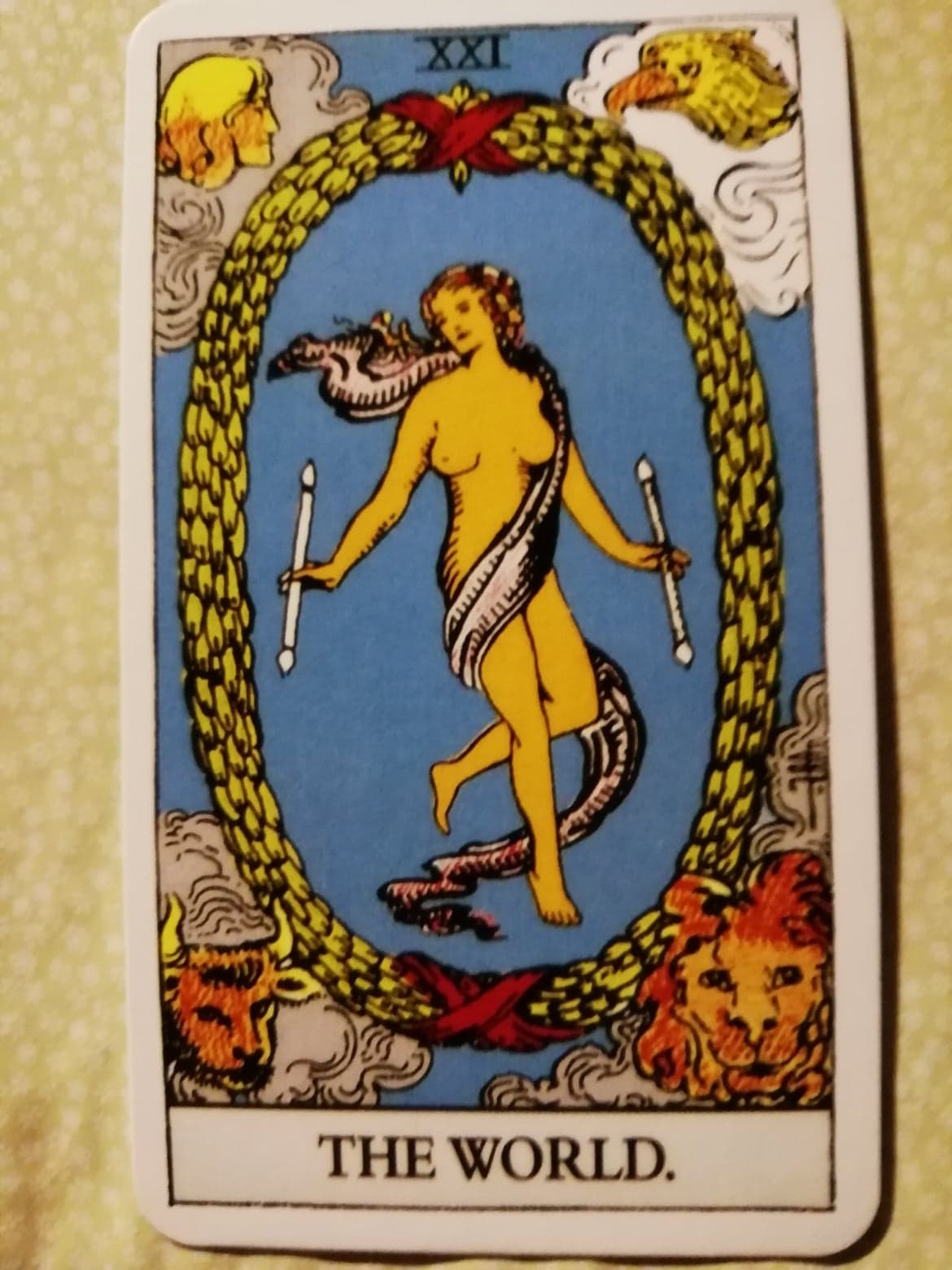
The last point reminds me a lot of the Journey of the Major Arcana of the Tarot. The person starts by understanding their conscious self and the way they manoeuvre in the material world around them, later on they go deeper into the subconscious and after many deaths and rebirths this ”journey of enlightenment” ends with the World card, in which we see the world dancer. In this card we have reached the super-conscious by combining and harmonising our understanding of the conscious and the subconscious mind. Rachel Pollack in her fabulous book ‘Seventy-eight Degrees of Wisdom’ says about the World Dancer: ‘What can we say of an understanding, a freedom and rapture beyond words? The unconscious known consciously, the outer and the inner unified with the forces of life, knowledge that is not knowledge at all but a constant ecstatic dance of being – thay are all true yet not true.’

Back to the point, Cage used divinatory methods such as the I-ching to create a music that represents this ideology. Music that isn’t about personal self-expression but about trying to reach a state of enlightenment in a sense, where the sound is free to act independently of the composer. The rebellion of sounds.

So, divination is helpful in creation to liberate you from your personal taste and cultural rhetoric, but it is also helpful in increasing your creativity. A creative confine always makes a person more imaginative.

I am a Tarot enthusiast and now I consult the Tarot before I start composing. I do this in two stages. Firstly, I do a reading on how I would go about composing and then I do a reading on the music itself, or whatever ideas I have for it to start with. For example, let’s say I have two musical lines to start with. I will do a reading for those two lines as if they were human querents, and that will create some very interesting and complex narratives for them. Even if your music isn’t very narrative, the tarot can help put all your material in a temporal state.

I started this method after a lesson of mine where my teacher pointed out that my compositions are a bit like paintings – one thing present in front of you – and that they don’t have much development, even though it feels like the sounds want to develop. Using the tarot to create narratives has worked amazingly for activating my imagination with regard to structuring my music. Even though most of my pieces are like exploring a landscape rather than going on a journey, that landscape should have a story implied in it. Maybe like a beautiful meadow with a miniscule, hardly visible pit full of dead foxes in the corner.

Lastly, these methods can really help musical introspection. What would the music’s conscious and subconscious be; how can sounds sounds have hopes and fears? We always think of sound having character, so why don’t we ever explore it more in depth?

I will be analysing these ideas further in my next blog where I will do a sample reading on one of the Sigil pieces that I want to reimagine/recompose for a different instrumentation.

Further readings/bibliography:

Rachel Pollack: Seventy-eight degrees of Wisdom

Charles Hamm: Privileging the Moment: Cage, Jung, Synchronicity, Postmodernism (The Journal of Musicology vol. 15 no. 2, p. 278 – 289)

Marc G Jensen: John Cage, Chance Operations, and the Chaos Game: Cage and the I-ching (The Musical Times, vol 150 no. 1907, p. 97 – 102

Peter J Carroll: Liber Null and Psychonaut

DIVINATORY MUSIC

Divination is not necessarily the prediction of future! For me it is seeking knowledge from within and therefore from nature. A form of introspection. However, the difference from normal introspection is that you have something external directing your thought in different directions. This could be tarot cards, runes, the I-ching etc.. It is as if you are consulting nature/chaos/the universe for answers. Even if you dont believe in any of the above you can see the external factors as a way of being creative and holistic with your thought process in order to prevent intellectual stagnation and wallowing.

I have heard many people rave about how much they love David Bowie’s lyrics, and how much they mean to them, but in fact most of his lyrics where cut-ups. A technique created by writer and occultist William S Burroughs as a form of divination. This method involves cuting up pieces of found text (i.e. from a newspaper) and then randomly putting them together. The human mind, even when processing random pieces of information the one after the other, creates narratives through them that bridge the discontinuities. These narratives, because of the non-sense of the juxtaposed and randomly ordered information, probably say much more about your worries and what has happened in your day so far, rather than highlight the original relations of the fragmented texts. The cut-up only creates an enviroment for your narratives to unfold and gives them dirrection. It has no inherent narrative of its own. Maybe only the ordering shows something about the person who created it.

This method is almost identical to the way the Tarot cards work, but in the Tarot you have pictures and symbols to interpret. Though again, it is about creating your own narrative which acts as a mirror to your internal universe.

Maybe this is why Bowie’s lyrics are so succesful. They speak to everyone because they dont preech, they imply and they show us our inner reality and potentiality. And everyone is interested in themselves.

Thoughts on improvisation

I have allways had mixed feelings about free group improvisation, as I have never experienced a truly satisfying one. Especially doing it in a Conservatoire where people are ‘good’ at their instruments, it can get quite self-involved. People start caring to much about sounding good/cool/edgy/extreme because they see this type of improvisation as an easy path to musical masturbation.

Musicians are highly self-aware and critical beings, therefore putting a group of them together and telling them to play freely can be quite crippling. For the execution of Sigil music, I tried a couple of methods that proved to be extremely fruitful.

CASTING A PROTECTIVE CIRCLE

Creating a safe space, where before we do anything musical we explore it with our bodies in many different ways. Run around the space, explore it in forms of different animals and explore it blindly. One hour of this will do the job. Make sure you play as much as you can! Everyone should make fools of themselves in order to feel physically free and committed.

TRANSITIVE VERBS

At the time of our first workshop I came across a theatre method by Stanislavski that uses transitive verbs to enhance performance. It very much works they same in music. In the workshop we all listened to the same thing at the same time and decided on our action verbs. The first time round everyone had a different one that they kept secret. This became quite unclear and confusing. Later on, we tried all deciding on one verb. Here things started to get interesting because you could clearly see the creative discourse. Especially when a verb was challenging, for example: ‘slice’ the sound you hear, the outcome was much more genuine and exploratory, because all the performers where forced to really engage their imaginations but also listen out for ideas and interact. This was the first time I saw musicians sacrifice their ego to this extent in search of truly expressive sound, because it wasnt about failure any more.It was about group consciousness and trance. It had the essence of an initiation ceremony, where everyone had to die in order to be reborn. And maybe that is what this piece is – a form of initiation.

How Sigils are translated into compositional process

Sigil Music is a piece for eight performers – eight friends of mine. My objective was to create music that could only played by the specific people – music that was about them and therefore not allowing any space for judgement of interpretation and pointless elitist performance practice commentary.

The process of creating the piece started by interviewing each individual. I found out about their taste in music, literature and cinema and talked to them about their dreams. Having collected this pool of information I was able to start creating the music.

STAGE I

Each performer gets a a piece written for them as a gift. The information from the interviews in addition to my relationship with them are factors that influence my compositional decision-making.

Before I start the piece I also write down a benign desire that I have for them (like in the first stage of making a sigil).

STAGE II

This is the stage of my musical composition. This involves translating all of the information into sounds as well as encrypting my desire for them. We will look into musical encryption in further blogs.

STAGE III

Now we have the finished piece from the composer’s behalf. In every case this is different because not all pieces are notated. The pieces are presented to the performers in the way that would create the most fruitful outcome, because everyone has very different musical background. In some cases I worked closer with the performer in a more collaborative/improvisatory manner and in others I made demos on Logic. This stage could be seen as the finished Sigil.

STAGE IV

This will be the charging of the sigil. The work the performer puts into the piece in order for it to manifest. The practice for their performance of the sounds.

STAGE V

By far the most complicated and exciting stage.

So far everything seems pretty orthodox in the context of western classical compositional method. However, in this stage all pieces are sacrificed, just like a sigil is destroyed in order for it to be forgotten and to become subconscious so it can manifest in the physical world. How this happens practically: Lets follow the journey of the piece written for performer X. The piece is written, practiced and recorded. In a workshop enviroment with all the performers apart from performer X, everyone listens to the recording through headphones and ‘interprets’ it. In the workshop me and the performers discuss the brief of every what every ‘interpretation’ will be in order to find a common one we are all happy with. For example: Mimic the performers breaths on your instrument, whistle your harmonisation of the ongoing line, create your own accompaniment on a toy instrument, disrupt all the sillent moments of the piece with a scream. X hears the interpreted version for the first time in the performance. And so on for every person.

Basically, we create a group improvisation based on a piece of music that the audience never hears. The work of the composer and the performer are sacrificed along with their ego and they are replaced by the ritualisation of a musical egregore. My work becomes an occult fiction which is an equal part of the improvisation as every single performer’s interpretation.

Sigils

In order for me to explain Sigil Music, I need to give a very brief introduction to Sigils beforehand.

Brief History

The word derives from the latin word “sigillium” which means seal. Sigils were used in medieval grimoires (book of spells) as symbols that gave the magician the ability to conjure angels and demons. They were revived in the mid 20th century by artist and occultist Austin Osman Spare who believed the medieval angel and demon to be nothing but complexes in the subconscious. Spare’s writings can be quite elusive, but we get the sense that, for him, sigils are symbols that he used in order to manipulate his subconscious mind (for more information refer to his book “The Zoetic Grimoire of Zos”). Towards the end of the 20th century Chaos Magicians used Spare’s theory as a cornerstone in their practise. For them, sigil magic is the ritual of symbolising a desire, destroying it (in order for it to be forgotten by the conscious mind) so it goes straight to the subconscious. Their belief is that when something is subconscious there is a bigger possibility for it to manifest in the physical plane (the sensory/material world). In your consciousness your desire interferes with your ego and subsequently it becomes more about a fear of failure. On the contrary, when a desire is subconscious it becomes what Spare calls “organic”. Some serpents had the ‘organic’ will to fly and then they got wings – became birds. The idea that your will can become the universe’s will is a rather attractive philosophy to live by. For further information on how Sigil Magic works I would highly recommend the book “Practical Sigil Magic” by Frater U.:.D.:..

How It Works

We are now going to look at how the Word Method of Sigil Making works.

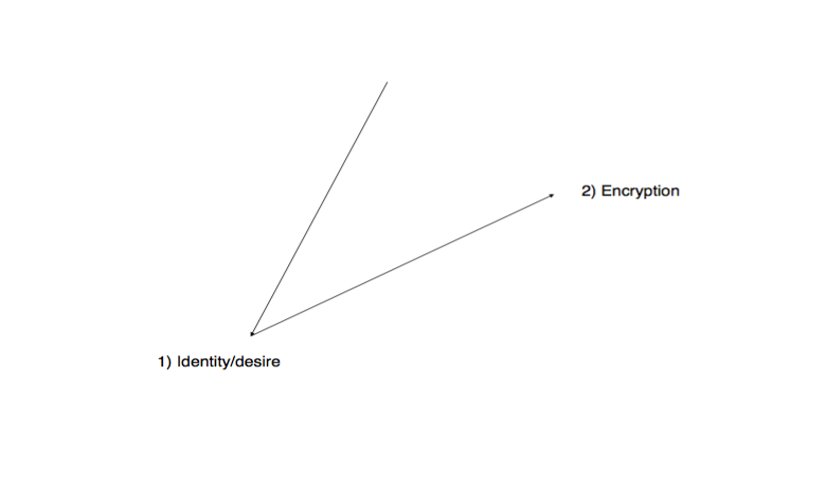
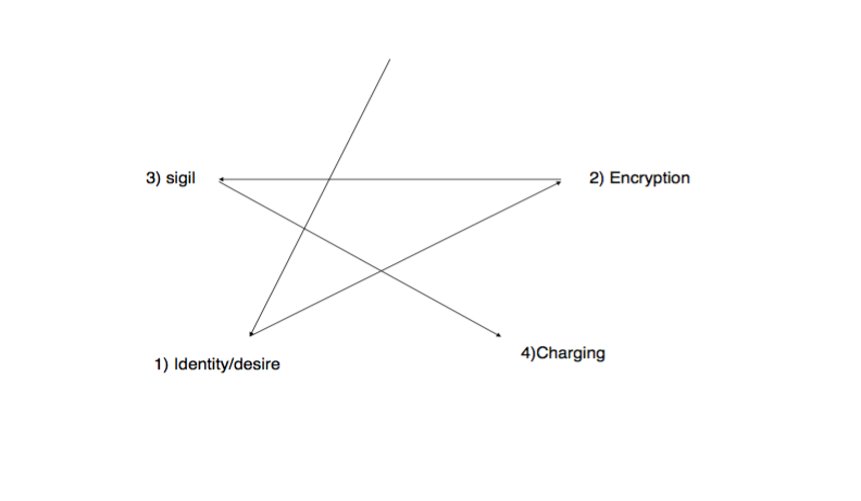
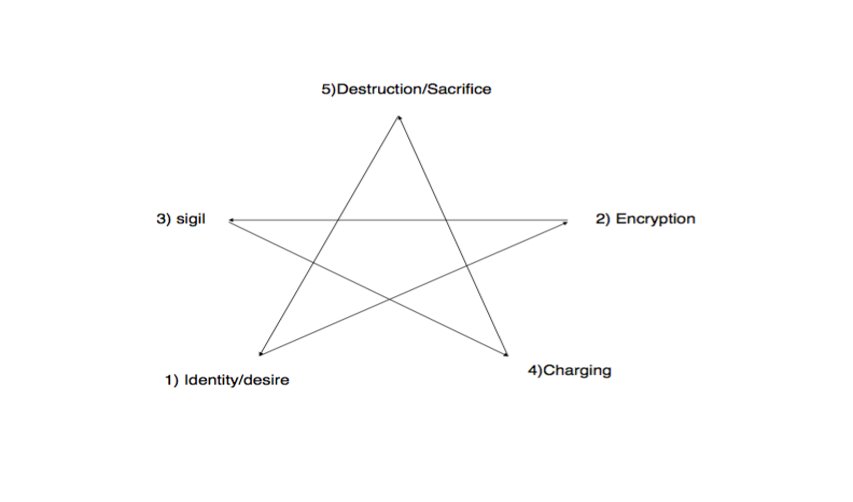
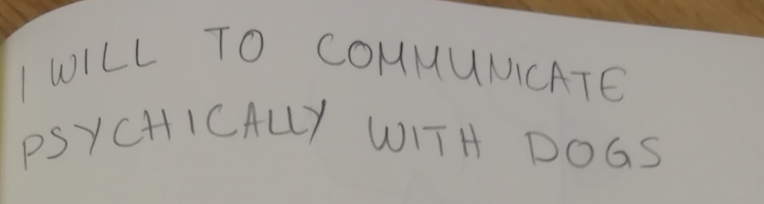
  1. Writing down the desire.

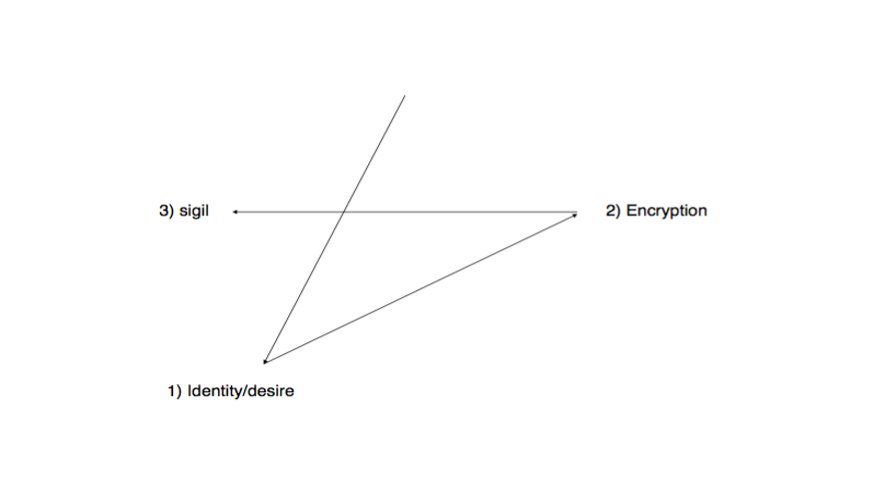
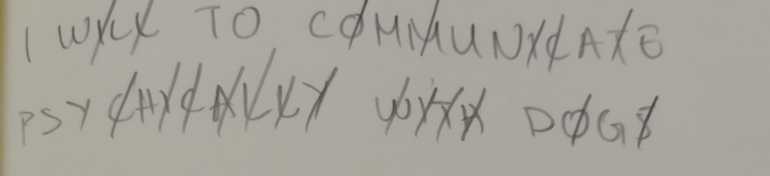
2. Encryption – Cross out all repeating letters until you’re left with a random strand of letters.

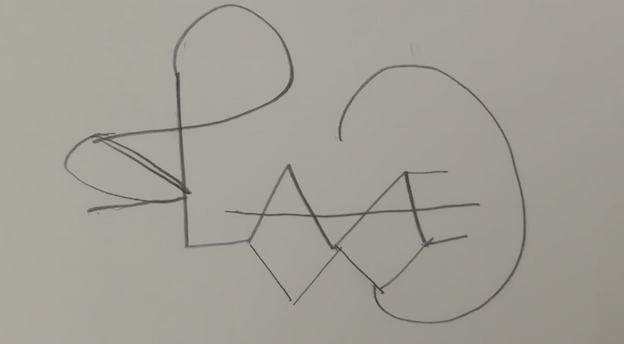
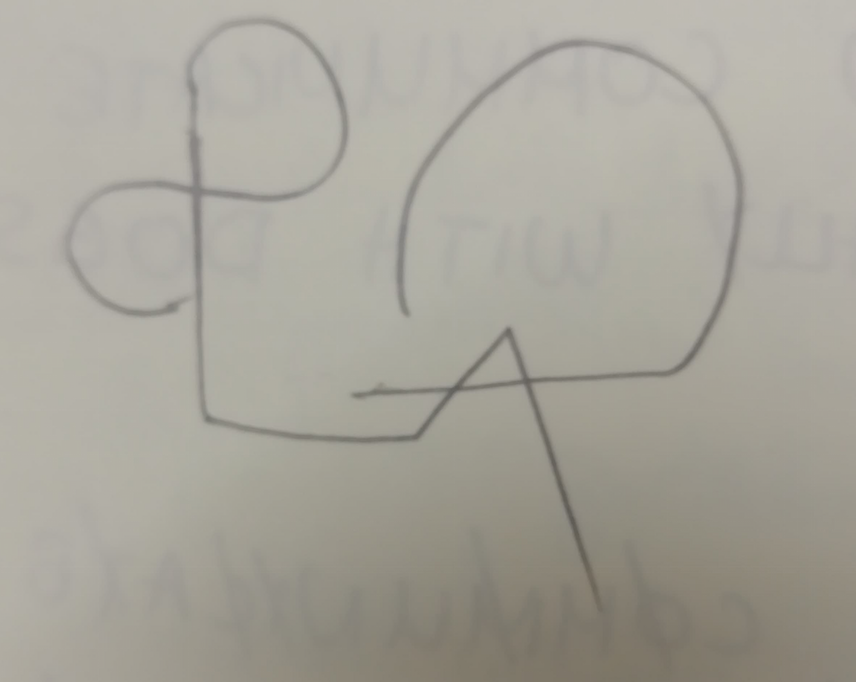
3. Creation of the Sigil – Create a calligraphic glyph with all of the above letters. Do it again and again until hardly no of the original letters are recognisable.

4. Charging the Sigil – Here you have to get in some sort of trance while looking at the sigil. Trance work is vital for most magical practices, so i would really recommend looking into it. However, some simple ways of charging sigils are: Masturbating and looking at the sigil without blinking at the point of orgasm, slight asphyxiation, doing a very simple gesture repeatedly and making quicker and quicker every time.

5. Destruction – For the desire to manifest you have to destroy the sigil. The most common and effective way is burning however it is encouraged for magicians to experiment. A method that I have been doing lately is sticking them on the back of my door. Because i see them so many times in the day they just become mundane objects.

An Introduction

In this space i will be discussing how musical creation can be viewed through a magical paradigm.

I will be sharing with you my research into an eclectic mix of occult practices and music and how I have applied it to my long scale project Sigil Music, as well as information on topics around this/in the area of aesthetics of experimental performance and spirituality.