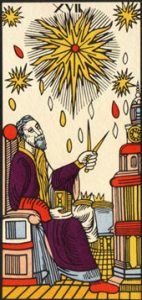

In the previous blog we discussed how the music itself can be the divinatory tool, taking the place of the Tarot deck, the crystal, the runes or the mirror. In this blog we will be looking into how divination can help us in creating music and what it teaches us about our craft.
We will start by looking into the music of John Cage and specifically Music of Changes and Imaginary Landscape No. 4. For the creation of Music of Changes (for solo piano) Cage used the I-ching, a chinese oracle book. He created charts where pitch material, dynamics and time corresponded with the numbered hexagrams of the book and by flipping a coin the decisions would be made (the exact process isn’t important for this text. For more information have a look at the further reading section at the end). Cage states that it’s a process of composition where ‘instead of making decisions, you are asking questions’. In Imaginary Landscape (for 12 radios) he created a score which indicated the situating of events (i.e. turn up volume of radio, change station, mute etc.). However, the events/the sound transmitted to the audience is not controlled by him or by the performer. It is dependent on the location of the performance, because that determines which radio stations would come up.
Cage spoke of ‘a musical composition of which the continuity is free of individual taste and memory (psychology) and also of the literature and ”traditions” of the art…Value judgements are not in the nature of this work as regards either composition, performance or listening. The idea of relation being absent, anything may happen.’
Cage’s thinking at the time was very much influenced by two major ideologies/theories: 1)Carl Jung’s theory of Synchronicity, sometimes defined as ”acausal connecting principle”, ”meaningful coincidence” and ”acausal parallelism”. Which is a theory that supports an interdependence between all objective events – a thought that all coincidence is not just mere chance but something more like a universal rhythm. This echoes ideas of many magical belief systems such as Karma and Chaos. 2) Mingling with Asian philosophies and mainly the writings of Ananda Kentish Coomaraswamy on aesthetics. Coomaraswamy loathed the idea which existed in western modernism, that of art as “masterpiece” of a “mastermind”. He believed western artists of the time were too self obsessed and that the fundamental nature of art lies in the ‘Unified being’ or ‘Ultimate Reality’, the evidence of whose existence lies in transcendental undifferentiated experience, a unified way of being where individuality and group consciousness, conscious and subconscious work together.
The last point reminds me a lot of the Journey of the Major Arcana of the Tarot. The person starts by understanding their conscious self and the way they manoeuvre in the material world around them, later on they go deeper into the subconscious and after many deaths and rebirths this ”journey of enlightenment” ends with the World card, in which we see the world dancer. In this card we have reached the super-conscious by combining and harmonising our understanding of the conscious and the subconscious mind. Rachel Pollack in her fabulous book ‘Seventy-eight Degrees of Wisdom’ says about the World Dancer: ‘What can we say of an understanding, a freedom and rapture beyond words? The unconscious known consciously, the outer and the inner unified with the forces of life, knowledge that is not knowledge at all but a constant ecstatic dance of being – thay are all true yet not true.’
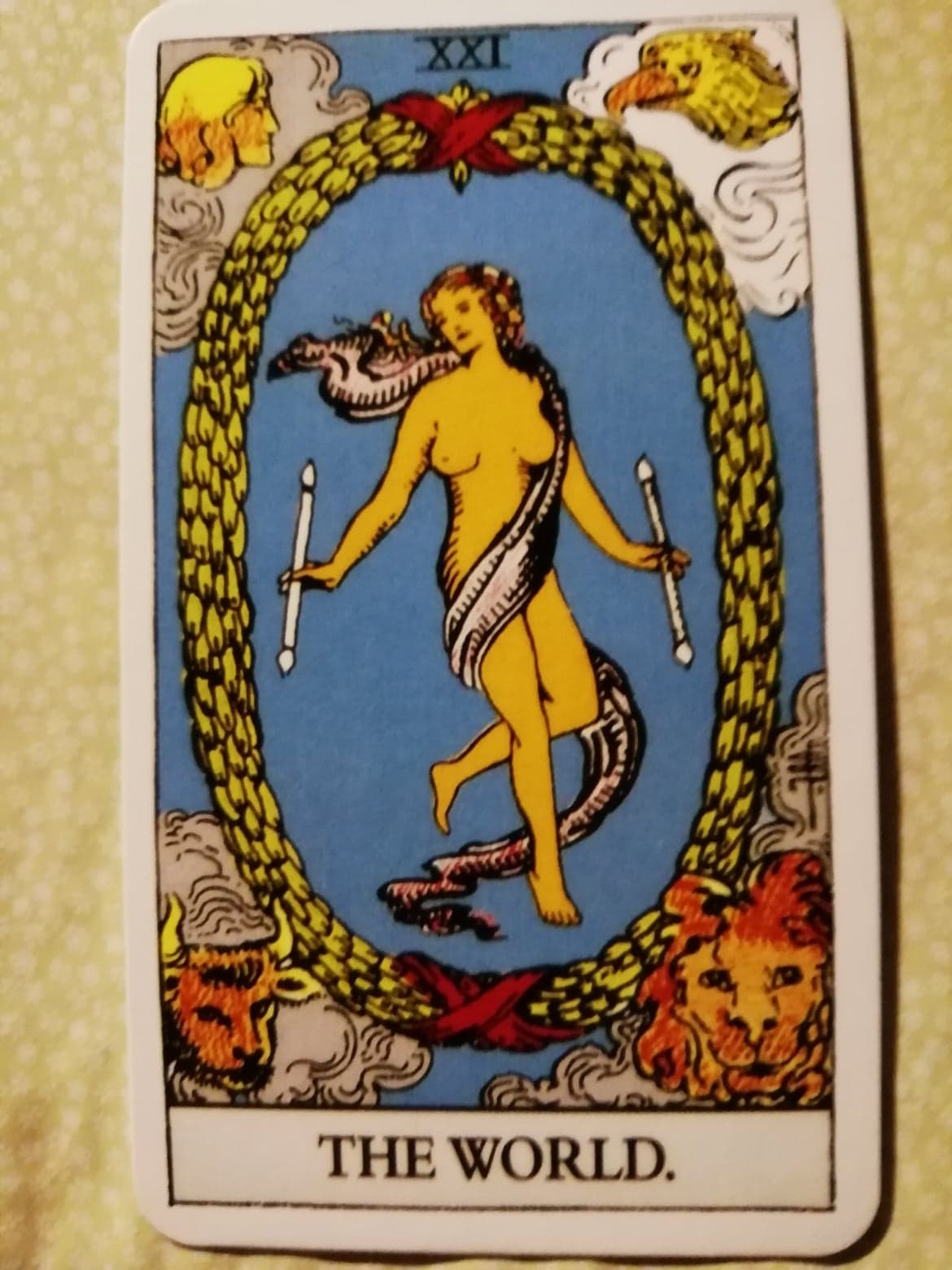
Back to the point, Cage used divinatory methods such as the I-ching to create a music that represents this ideology. Music that isn’t about personal self-expression but about trying to reach a state of enlightenment in a sense, where the sound is free to act independently of the composer. The rebellion of sounds.
So, divination is helpful in creation to liberate you from your personal taste and cultural rhetoric, but it is also helpful in increasing your creativity. A creative confine always makes a person more imaginative.
I am a Tarot enthusiast and now I consult the Tarot before I start composing. I do this in two stages. Firstly, I do a reading on how I would go about composing and then I do a reading on the music itself, or whatever ideas I have for it to start with. For example, let’s say I have two musical lines to start with. I will do a reading for those two lines as if they were human querents, and that will create some very interesting and complex narratives for them. Even if your music isn’t very narrative, the tarot can help put all your material in a temporal state.
I started this method after a lesson of mine where my teacher pointed out that my compositions are a bit like paintings – one thing present in front of you – and that they don’t have much development, even though it feels like the sounds want to develop. Using the tarot to create narratives has worked amazingly for activating my imagination with regard to structuring my music. Even though most of my pieces are like exploring a landscape rather than going on a journey, that landscape should have a story implied in it. Maybe like a beautiful meadow with a miniscule, hardly visible pit full of dead foxes in the corner.
Lastly, these methods can really help musical introspection. What would the music’s conscious and subconscious be; how can sounds sounds have hopes and fears? We always think of sound having character, so why don’t we ever explore it more in depth?
I will be analysing these ideas further in my next blog where I will do a sample reading on one of the Sigil pieces that I want to reimagine/recompose for a different instrumentation.
Further readings/bibliography:
Rachel Pollack: Seventy-eight degrees of Wisdom
Charles Hamm: Privileging the Moment: Cage, Jung, Synchronicity, Postmodernism (The Journal of Musicology vol. 15 no. 2, p. 278 – 289)
Marc G Jensen: John Cage, Chance Operations, and the Chaos Game: Cage and the I-ching (The Musical Times, vol 150 no. 1907, p. 97 – 102
Peter J Carroll: Liber Null and Psychonaut
 Sigil Music